
Coffee with Esther (March 2026)
Less Guessing, More Scoring: Taking Charge With the mJOA
Spring is just around the corner. The daffodils are peeking up, the days are getting lighter, and here we are talking about something equally uplifting: a scoring system! Yes, I know. Try to contain your excitement.
Last month in our Virtual Coffee Break sessions, we talked about being your own advocate at medical appointments. Not in a “storm the castle” kind of way. Not a blame-game for consultants. But in a calm, confident, “I know my body and I’ve brought receipts” kind of way. And that’s where the mJOA scoring system comes in.
What Is the mJOA?
The Modified Japanese Orthopaedic Association (mJOA) score is a clinical scoring system used to measure the severity of Degenerative Cervical Myelopathy (DCM).
In plain English? It’s a structured way of measuring how much your spinal cord compression is affecting you.
It looks at things like:
- Hand function (buttons, writing, fiddly tasks)
- Walking and balance
- Bladder function
- Arm and leg strength
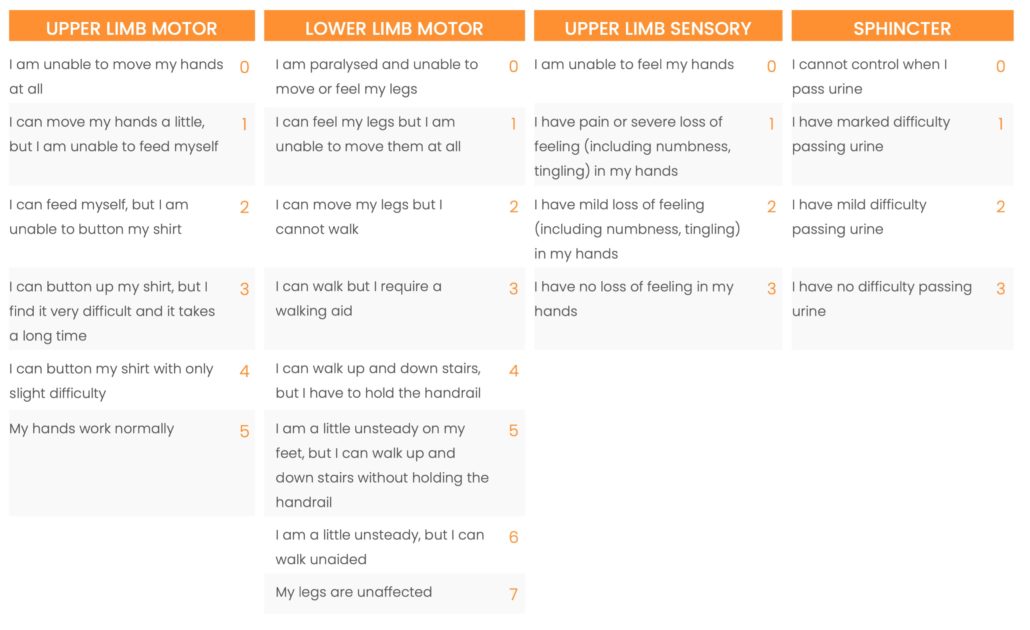
You’re given a score based on how well you’re functioning in these areas.
The lower the score, the more severe the symptoms.
Severity Categories
The total score is used to classify the disease into three levels of severity:
- Mild: 15–17 points
- Moderate: 12–14 points
- Severe: 0–11 points
It’s not there to label you. It’s there to measure change and measuring change is powerful.
Why Does the mJOA Matter?
Because feelings are valid, but numbers get attention. When you can say, “My mJOA score was 15 three months ago and now it’s 12.” That’s not vague. That’s evidence. Consultants work with measurable information.
The mJOA gives you a shared language. It moves the conversation from: “I just don’t feel right…” to “Here is documented functional decline.”
That’s a very different conversation.
The Superpower of a Symptom Diary
Now let’s talk about your secret weapon: your diary tracker. Not the fluffy “Dear Diary” kind (unless you want that, no judgement). A proper symptom tracker might include: date, pain levels, changes in walking, numbness or weakness, bladder changes, falls or near misses, fatigue levels. Patterns appear when you write things down.
You might notice: symptoms worse at certain times, gradual deterioration, increased frequency of issues.
And when you combine your mJOA score + your diary, you are no longer just explaining, you are demonstrating. That’s powerful.
Preparing for Your Consultant Appointment
Think of it like preparing for a meeting. You wouldn’t turn up to a job interview and say, “I think I’m good at stuff.” So don’t do that with your Myelopathy symptoms either.
Before your appointment:
- Bring your latest mJOA score
- Bring your symptom diary
- Write down your questions
- Take someone with you if possible
And if you feel you’re not being listened to, here are calm, reasonable questions you are absolutely entitled to ask:
- “Can you explain why you don’t feel I need further tests or referral?”
- “What results are you basing that decision on?”
- “Could you please document in my notes that I requested further investigation today and that it was declined?”
That’s not confrontational. That’s accountability.
If they say “we need to wait and see,” ask, “How long are we waiting?” “What changes would make you reconsider a referral?” “What should I monitor in the meantime?”
Timeframes matter. Clarity matters. Documentation matters.
If you still feel unheard, you are allowed to request a second opinion. You have the right to a second opinion. You know your body. You live in it 24/7. You notice changes before anyone else. Seeking further help is not dramatic. It’s responsible.
Spring Is a Good Time to Start
With the daffodils blooming and lighter mornings ahead, maybe this is your season to start tracking symptoms, learn your mJOA score, prepare properly for appointments and Take control of your healthcare journey. Not aggressively. Not anxiously. Confidently.
Join Us This Month
Our Virtual Coffee Breaks are on as usual. They’re relaxed, supportive, informative and yes, we do occasionally go off topic. We can normally make someone blush, but these questions need answering! If you’re not already in the community, make sure you join the Myelopathy Support Groups on Facebook to get the session links.
Bring your coffee.
Bring your questions.
Bring your diary if you’ve started one.
And remember: Being your own advocate doesn’t mean fighting the system. It means learning how to navigate it.
See you at the next Virtual Coffee Break.
Esther