
Coffee with Esther (July 2025)
Stay Cool and On the Move: Smart Tips for Hot Days
Welcome to our latest Virtual Coffee Break blog, otherwise known as, “A Group of Us Bonding Over the Heat While Secretly Loving the Chat.”
We gathered with fans whirring and drinks in hand. But what started as a simple weather whinge turned into a brilliant discussion about coping in the heat, preserving our precious energy, and most importantly, mobility aids.
First Things First, Surviving the Heat Without Melting
Let’s be honest, most of us are built more for mild drizzle than Sahara-level sun. But
we came armed with top tips for surviving the Great British Heatwave:
- Frozen flannel/ Myelopathy bandana to the back of the neck: It’s like a hug from the inside of a fridge.
- Chilling your wrists under cold water: Simple, free, and feels like black magic.
- Curtains shut during the day: Because we are not inviting the sun into this house.
- Stay hydrated: That means water, folks; not just tea and cheeky lemonade.
- Spray bottles and mini fans: Because if we’re going to melt, we may as well feel like we’re at the swimming pool or beside the sea.
Of course, all this talk about staying cool got us thinking: we spend so much time and energy just trying to move, get around, and stay independent, how do we save energy for the things we love, like laughing, seeing friends, or watching telly without collapsing afterwards?
When Should You Start Using a Mobility Aid?
This is a tough question. But really, when is the right time to start using something to help you walk, roll, scoot, or glide?
The answer? When getting around starts to feel like climbing Everest wearing roller skates and carrying a bag of spuds. If walking from the front door to the car feels like a triathlon, it might be time to consider some help. And no, it’s not giving up. It’s getting ahead. It’s about saying “I’d rather use this aid and still go out for a stroll with my mate than stay home just because I’m trying to act tough.”
From Sticks and Crutches to the Big Leagues
For many of us with Myelopathy, we start slowly by using walking sticks or crutches. They do a decent job of keeping us upright, stopping the wobbles, and helping us walk in a straight-ish line. But at some point those sticks start to feel like dragging along two grumpy toddlers who are absolutely not helping anymore.
***
The Rollator (aka Your New Best Friend on Wheels)
If you haven’t tried a rollator, think of it like a posh shopping trolley, but with a seat, brakes, and no judgment.
Top Tip: Get one with a seat. That way, when you’re out and about and your legs send up the white flag, you’ve got a chair at the ready. Instant rest stop. It’s like having a picnic bench follow you around.
Pros:
- Helps with balance, posture, and not looking like you’ve had three pints at lunchtime.
- Great for longer trips to town, the park, or even just the kitchen.
- Storage space underneath for snacks, water bottles, or a sneaky bottle of wine! (I’m kidding)
Cons:
- Can be a bit bulky in shops, prepare for some tight corner manoeuvres.
- Doesn’t love hills. Or gravel. Or potholes (but then, who does?).
***
We were chatting away, when Helen casually drops this bombshell: “Oh, I’ve got an electric rollator, it turns into a wheelchair when I get tired.”
Excuse me, what?!
Turns out, this marvellous contraption lets you walk when you’re feeling good, then flips into an electric wheelchair when you’re not. It’s basically the Batmobile of walking aids.
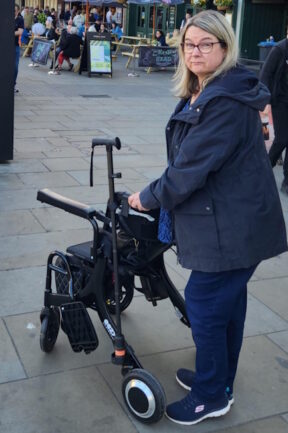

Pros:
- Encourages walking while offering a backup plan.
- Can be pushed manually or driven with electric power.
- Ideal for day trips when your legs start planning their mutiny.
Cons:
- Might need a charging station next to your kettle.
- Likely to make other people jealous.
***
My trusty fold-away electric chair (aka Esther’s Chariot) I’m now in the “short distances only” club. I can do a bit of walking with support, but after that, it’s game over. Enter my trusty fold-away electric wheelchair. It’s lightweight, folds up like a pram, and doesn’t require a forklift to lift into the car. I chose this because my arms and hands are about as strong as overcooked spaghetti. Peeling a banana is a full-body workout!
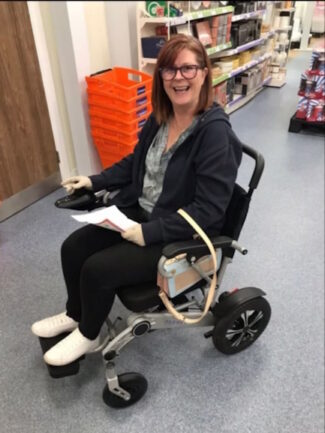

Pros:
- Easy to transport and store.
- Doesn’t need strong arms (hallelujah).
- Quiet, smooth, and reliable.
Cons:
- Limited range on a full battery—like a budget airline, but for chairs.
- Can be tricky on uneven ground (avoid cobbles unless you enjoy surprise core workouts).
***
Foldable scooters. Push button, get freedom. Next on the list of “I didn’t know I needed that until someone showed me” are foldable scooters. These gadgets literally fold themselves at the push of a button. Some even come with remote controls. Because apparently we now live in the future.
Pros:
- Great for day trips, cruises, city breaks, even shopping centres.
- Compact and surprisingly zippy.
- Makes you feel like James Bond’s less athletic cousin.
Cons:
- Limited off-road ability.
- Buttons may encourage unnecessary folding just to show off.
***
The manual-electric hybrid chair. Push now, zoom later! These clever chairs let you start with manual effort (great if you still have some upper body strength), and when your arms say “That’s enough, thanks,” you clip on a powered front wheel and glide the rest of the way.
Pros:
- Flexible and adaptable.
- Encourages exercise, without trapping you halfway home.
Cons:
- Can be pricey depending on brand.
- Some assembly (and patience) required.
***
Indoor powered chairs. For your home sweet home! These chairs are built like dodgems but less violent. Compact, agile, and perfect for buzzing from bedroom to bathroom to the kitchen and popping on the kettle and getting the biscuit tin.
Pros:
- Great for saving energy at home.
- Makes chores feel slightly less chore-y.
Cons:
- Not built for outdoors (unless you enjoy breaking down halfway to the bins).
***
The Scooter Gang – 2/3 Wheel Wonders
One of our crew rides a 2- or 3-wheeled scooter and swears it gave him back his independence, as well as a bit of street cred, too! Especially in his bike helmet and knee pads.
Pros:
- Easy to use, especially if you’re still relatively mobile.
- Fun. Like, really fun!
Cons:
- Stability isn’t perfect on tricky terrain.
- Your balance has to be good
- Needs to be charged up, so needs to be stored where there is electric.
- Some fold up, others don’t, so storage could be an issue.
***
And finally… The WOW Chairs! These are the Rolls-Royces of mobility aids. Voice controlled, 4×4, off-road terrain crushers that can take you through the woods, onto the beach, or across muddy fields like an all-terrain tank. If you ever see one of these, prepare to be amazed, and maybe slightly intimidated.
Pros:
- Ultimate freedom.
- Built for adventure and adrenaline.
Cons:
- Cost = eye-watering.
- Storage = garage (or barn).
***
Final Tip: go second hand and go sooner. Many of these devices are available second hand, lightly used, barely scratched, and hundreds of pounds cheaper. People often wait too long to buy mobility aids, and by then, they can’t benefit from them as much.
Don’t wait until you’re running on fumes, get something that helps you enjoy life now. Mobility aids aren’t about giving in. They’re about getting OUT! They’re about getting on with life. Whether you’re cruising, zooming, scooting, or transforming into a slightly sweaty superhero on your 4×4 terrain wheelchair, blazing through the woods like nature’s fastest legend, if it helps you stay independent and involved, it’s worth its weight in gold.
So don’t be shy. Don’t be embarrassed. Be the one who gets to the park, joins the group outing, and isn’t exhausted or the only one at home.
If you’re hiding from the sun over the next few months, why not join us at the next Virtual Coffee Break? And if you’ve found an amazing gadget that’s out there, pop on and do a “show and Tell” to us all! If it folds at the push of a button? Even better!
Until next time, stay cool, stay independent, and keep rolling!
Esther