
Campaigning for Change: Iwan Sadler on Myelopathy.org, the SIA Award and Why the Work Must Continue
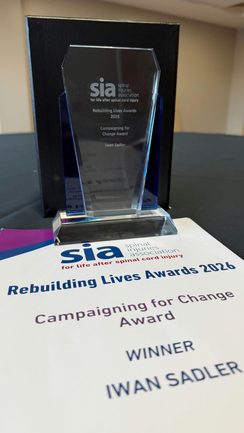
Winning the Spinal Injuries Association’s Campaigning for Change Award 2026 was an emotional moment for Iwan Sadler.
But for him, it’s not just about recognition; it’s about how far Myelopathy.org has come, and how far there still is to go.
In this interview, he reflects on awareness, progress, and why the work must continue.
***
Why is the Spinal Injuries Association conference such an important event for Myelopathy.org, and what opportunities does it create for the charity to connect, learn and raise awareness?
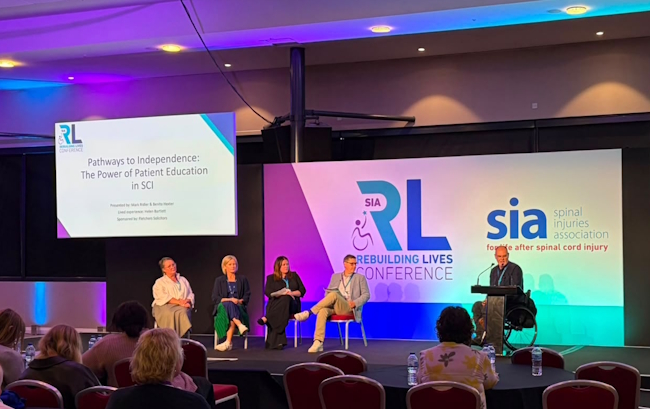
The Spinal Injuries Association’s Rebuilding Lives event is important because it gives us the opportunity to connect with other organisations, professionals and people affected by spinal cord injury.
For a relatively small charity like Myelopathy.org, those connections are incredibly valuable.
Degenerative Cervical Myelopathy, or DCM, affects the spinal cord and can develop gradually rather than through one sudden traumatic event.
I sometimes describe it as a slow motion spinal cord injury.
For many people, symptoms develop over months or years. They may not realise their spinal cord is being affected, and unfortunately healthcare professionals do not always recognise it quickly either.
So having DCM represented within the wider spinal cord injury community is really important.
Events like Rebuilding Lives give us an opportunity to network, learn from other organisations, speak to professionals, develop relationships and raise awareness of a condition that is still not widely understood.
Ultimately, everything comes back to reaching people earlier and making sure fewer people are left wondering what is happening to them.
What first made you decide to start campaigning for greater awareness and change around Myelopathy?
When I first became involved in raising awareness of Degenerative Cervical Myelopathy, very few people seemed to know what it was.
I certainly hadn’t heard of Myelopathy myself.
If you searched online for DCM around 11 years ago, much of what appeared related to canine DCM. There was very little accessible information for people trying to understand what was happening to them.
That was really where my campaigning began.
At first, I wasn’t setting out to create a charity or even a support group.
Facebook was probably the biggest social media platform at the time, and I simply started using my design skills to create posts and raise awareness wherever I could.
I probably became a bit of a pain.
I posted in groups, shared information and occasionally got kicked out of groups for campaigning about DCM, sometimes even groups connected with the condition itself.
But I kept going.
Ben Davies, who later became one of the co founders of Myelopathy.org, reached out and asked if I would share my story.
I did, and the response changed things for me.
you only need one person to read something you have shared and think, “That sounds like me” for it to potentially make a difference.
It made me realise that you only need one person to read something you have shared and think, “That sounds like me” for it to potentially make a difference.
One person might recognise something in their own symptoms.
One person might feel less alone.
One person might finally know what question to ask.
That made me realise the power of awareness.
I had always enjoyed design as well, so creating graphics and campaigning became a coping mechanism for me.
I could take something difficult that had happened in my own life and try to use it to help somebody else understand what might be happening to them.
Over time, that campaigning grew into something much bigger.
Myelopathy.org has now been raising awareness for around 11 years, and in 2018 we became a registered charity.
Iwan, when you heard that you had won the Spinal Injuries Association’s Campaigning for Change Award 2026, what was the very first thing that went through your mind, and who did you think of?
Unfortunately, I wasn’t able to attend the awards in person because of the symptoms I have been experiencing and the difficulty of travelling at the moment.
I was really disappointed not to be there.
So when the award was announced, I was actually at home in bed when Esther sent me a WhatsApp message telling me that I had won.
I became quite emotional.
There was obviously excitement, but there was also disbelief.
I genuinely hadn’t expected to win, and I was sad that I couldn’t be there in person to experience the moment.
But my thoughts very quickly went to everybody who has helped build Myelopathy.org over the years.
The trustees, volunteers, researchers, clinicians, supporters and, of course, our community.
This award might have my name attached to it, but the campaigning has never been about one person.
It represents years of work by so many people and, most importantly, the people living with Myelopathy whose experiences are the reason we keep pushing for change.
There is also a very personal connection between you and the Spinal Injuries Association, isn’t there?
There is, and that is another reason this award means so much to me.
When Myelopathy.org became a registered charity in 2018, we launched at the House of Lords.
One of the moments from that day that has always stayed with me was having the privilege of sitting next to the late Baroness Masham of Ilton.
We had a lovely conversation, and it is something I have never forgotten.
From sitting beside the late Baroness Masham of Ilton at the launch of Myelopathy.org at the House of Lords in 2018, to receiving the Spinal Injuries Association’s Campaigning for Change Award in 2026, it really does feel as though things have come full circle.
Baroness Masham founded the Spinal Injuries Association, so that connection makes this award particularly special to me.
I could never have imagined, sitting there with her at the beginning of Myelopathy.org’s journey as a charity, that years later I would receive an award from the organisation she founded for the campaigning work we have all done.
Beyond the excitement of winning, what does this award mean to you personally?
Campaigning can sometimes feel as though you are shouting into the wind.
You can put huge amounts of energy into something and still wonder whether anybody is listening.
There have certainly been times when I have questioned whether we were actually getting anywhere.
There have been periods when things seemed to stagnate, when progress felt painfully slow and when my own health made everything harder.
Winning this award has almost relit the flame for me.
It reminds me that the work is being noticed.
More importantly, it reminds me that the work is making a difference.
When you live with the condition yourself, campaigning becomes very personal.
You understand the frustration of delayed diagnosis.
You understand the uncertainty.
You understand how much something affecting your spinal cord can impact everyday life, your family and your future.
That is what has always kept me going.
Myelopathy.org is a relatively small charity tackling a very big problem. What does an award like this do for a small organisation, not just in terms of visibility, but in making people sit up and take the condition seriously?
Recognition like this gives the charity credibility and visibility.
It makes people who may never have heard of Myelopathy stop and ask what it is.
That matters.
It can also open doors.
It gives us opportunities to network with larger organisations, researchers, healthcare professionals and potential supporters.
It can create partnerships and conversations that might otherwise never happen.
And realistically, small charities also need funding.
The more people who know who we are and understand why this work matters, the better our chances are of bringing in donations and support that allow us to do more.
But for me, the most important thing is still awareness.
If an award like this means one more clinician learns about DCM, one more patient recognises their symptoms, or one more family finds the information and support they need, then it has achieved something valuable.
Campaigning for change can be slow, frustrating and sometimes quite personal. Was there ever a moment when you wondered whether you were actually getting anywhere, and what kept you going?
Definitely.
There have been plenty of moments when progress felt incredibly slow.
You can work on something for months and wonder whether anybody has noticed.
But then somebody gets in touch.
They might tell you that a post helped them understand something.
They might say they finally found other people who understood what they were experiencing.
They might simply say, “Thank you, I don’t feel so alone now.”
Those moments remind you why you started.
And none of this happens alone.
One of the biggest lessons from the last 11 years is that you cannot build something like Myelopathy.org by yourself.
How important have the volunteers and the wider Myelopathy.org team been to that journey?
Our volunteers really are the backbone of Myelopathy.org.
I want to give a special shout out to Esther, Helen and Lorraine.
We have our WhatsApp group where we are constantly sharing ideas, talking about campaigns, discussing fundraising and thinking about what we can do next.
I genuinely couldn’t do what I do without them.
Then there’s Sheila and Karen, who do so much in our support group as admins and moderators.
They help support people, keep conversations running smoothly and help make sure the group remains a safe and welcoming place.
Again, I couldn’t do it without them.
There are also many other people who contribute in different ways.
Some people bring professional expertise.
Some help with research.
Some help with social media.
Some write blogs.
Some help behind the scenes.
Some give their time simply to support another person who is struggling.
And lived experience itself has enormous value.
Our community is a huge part of Myelopathy.org.
Every time somebody shares their experience, supports another person or helps explain Myelopathy to somebody who has never heard of it, they are contributing to change.
That is why I don’t see this award as mine alone.
It belongs to everybody who has helped Myelopathy.org get to where it is today.
Our volunteers, trustees, researchers, healthcare professionals, supporters, carers, families and, above all, the people living with Myelopathy.
Awards celebrate what has already been achieved, but what change do you still want to see for people living with Myelopathy?
We have made progress, but there is still a great deal more to do.
I want people to be diagnosed earlier.
I want healthcare professionals to recognise the symptoms more quickly.
I want people to get appropriate investigation and treatment before avoidable deterioration occurs.
And I want better support for people living with the consequences of Myelopathy.
The support has to go beyond Facebook groups.
Online communities are incredibly important and have helped thousands of people feel less alone, but we need Myelopathy to be recognised properly throughout healthcare systems and within the wider spinal cord injury community.
People should not have to spend months or years wondering what is wrong with them.
They should not have to become an expert in their own condition just to get somebody to listen.
We need awareness at every level.
Finally, what comes next for Myelopathy.org, and what would you say to somebody who wants to help but thinks they have nothing to offer?
The answer is simple.
We keep growing.
We keep networking.
We keep raising awareness.
We keep reaching people living with DCM and other forms of Myelopathy.
And we keep finding ways to bring in the funding that allows the charity to do more.
I would also love people within our community to realise that they can make a difference too.
Sometimes people think, “What could I possibly offer a charity?”
But something that feels small to you might be exactly the skill we need.
You may be able to write.
You may be good at design.
You may be able to organise things.
You might have fundraising ideas.
You might be good at social media.
You might have professional skills or contacts that could help us.
Or you might simply be somebody who can listen and support another person who is having a difficult day.
Never assume your contribution is too small.
Eleven years ago, I was simply creating a few graphics and posting information on Facebook because hardly anybody seemed to be talking about Myelopathy.
I certainly didn’t imagine that one day I would be receiving a Campaigning for Change Award from the Spinal Injuries Association.
That is probably the biggest message I would like people to take from all of this.
One person really can make a difference.
And when enough people decide to make that difference together, that is when things begin to change.