
Spotting Myelopathy Sooner: The East Midlands Warning Card
Most people with neck pain, arm pain, numbness or weakness do not have anything serious, and most do not need urgent medical attention. Degenerative Cervical Myelopathy is the uncommon exception, and it is the one worth catching early. DCM is a progressive condition in which the spinal cord is compressed in the neck. Left alone, it can cause permanent nerve damage and lasting disability. Caught early, treatment can stop that happening.
The difficulty is that the early signs are easy to miss, and easy to put down to something else. Clumsy hands. Trouble with buttons. Feeling unsteady on your feet. Taken one at a time they sound like nothing much. Together they can mean something quite specific.
A Card That Puts the Signs in One Place
In 2023 the East Midlands Spinal Network developed a warning card for DCM. We helped, and so did our community: people living with DCM reviewed and commented on the early designs. It is a small, two-sided card, available in print and electronically, designed to be handed to a patient in a clinic.
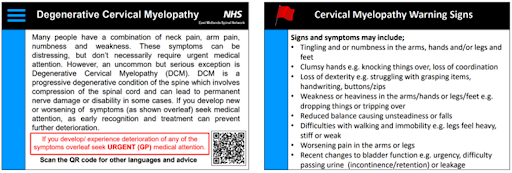
One side explains what DCM is and why new or worsening symptoms are worth acting on. The other lists the signs to watch for:
- Tingling or numbness in the arms, hands, legs or feet
- Clumsy hands, such as knocking things over or losing coordination
- Loss of dexterity, such as struggling with grasping, handwriting, buttons or zips
- Weakness or heaviness in the arms, hands, legs or feet, leading to dropping things or tripping
- Reduced balance causing unsteadiness or falls
- Difficulty walking, with legs that feel heavy, stiff or weak
- Worsening pain in the arms or legs
- Recent changes to bladder function, including urgency, difficulty passing urine, incontinence, retention or leakage
The card carries a clear instruction: if any of these symptoms appear or get worse, seek urgent medical attention from your GP. A QR code links to further advice and to versions in other languages.
Does It Actually Help?
A card is only worth printing if the people handing it out find it useful. So the East Midlands Spinal Network asked them.
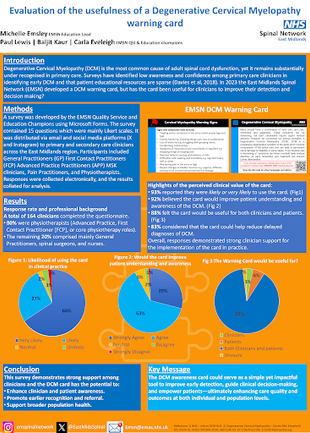
Paul Lewis, together with Baljit Kaur and Carla Eveleigh, Quality Service Improvement and Education Champions, surveyed clinicians across the region. The survey went out by email and social media to GPs, first contact practitioners, advanced practice practitioners, musculoskeletal clinicians, pain practitioners and physiotherapists. 164 clinicians responded. Four in five were physiotherapists of one kind or another; the rest were mainly GPs, spinal surgeons and nurses.
The results were striking:
- 93% said they were likely or very likely to use the card in practice
- 92% thought it would improve patients’ understanding and awareness of DCM
- 88% considered it useful for clinicians and patients alike
- 83% thought it could help reduce delayed diagnoses
The team presented these findings as a poster earlier this year.
Why This Matters To Us
DCM is the most common cause of spinal cord dysfunction in adults, and it is still under-recognised in primary care. Research our founders contributed to in the BMJ in 2018 found low awareness and low confidence among primary care clinicians in identifying DCM early, and very little in the way of educational material for patients. The people we support tell us the same thing in plainer language: it took a long time before anyone named what was happening to them.
Delay is not a neutral thing in DCM. The longer the spinal cord stays compressed, the more of the damage becomes permanent. Anything that shortens the road to diagnosis is worth having, and a card costs almost nothing.
What Happens Next
The East Midlands Spinal Network would like the card endorsed nationally, and we are keen to help make that happen. The next step is gathering feedback from patients, since the evaluation so far has asked clinicians what they think. We will be supporting that work and will share how to take part once arrangements are confirmed.
In the meantime, the card is available from the East Midlands Spinal Network. If you are a clinician, print it and keep some in clinic. If you are living with DCM, or supporting someone who is, it may be a useful thing to show to a GP who is not yet sure what they are looking at.
Download the card at https://www.eastmidlandsodn.org/degenerative-cervical-myelopathy-card.html
With thanks to Paul Lewis, Baljit Kaur, Carla Eveleigh and Michelle Emsley of the East Midlands Spinal Network, and to the members of our community who commented on the early designs.
References
Davies BM, Mowforth OD, Smith EK, Kotter MR. Degenerative cervical myelopathy. BMJ 2018; 360: k186.
Emsley M, Lewis P, Kaur B, Eveleigh C. Evaluation of the usefulness of a Degenerative Cervical Myelopathy warning card. East Midlands Spinal Network, 2026.