The Faces Behind the Miles: Kirsten
In this edition of The Faces Behind the Miles, we’re proud to introduce another inspiring member of our Miles for Myelopathy community. Recently diagnosed and still coming to terms with life-changing symptoms, Kirsten is turning her experience into something powerful: taking on incredible open water swimming challenges to raise awareness and vital funds. From navigating chronic pain and uncertainty to pushing herself through physically demanding swims, her story is one of determination, courage, and making every moment count while she can.
Can you tell us a little about yourself and your journey with Myelopathy?
I’m 51 and fairly new on my Myelopathy journey, having only been diagnosed with DCM last autumn. I’m married to Simon, who is absolutely wonderful and without whom I would fall apart, and we have an adult daughter (if you can really call a 21-year-old that?!), Amelia, who is a SEND primary school teacher.
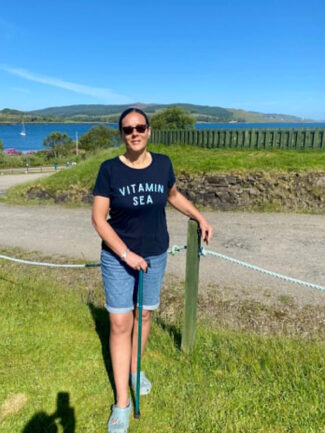
We live in the North East of England which means I have some stunning coastlines to swim in. Until my body decided to put a stop to my ability to work, I was a paediatric oncology social worker and latterly a psychotherapist, but sadly, because of ill health, I had to leave work (I have a widespread chronic pain & fatigue condition and arthritis in many joints).
What inspired you to take part in fundraising and awareness activities this month? You’re completing an amazing challenge — what are you doing, and why did you choose it?
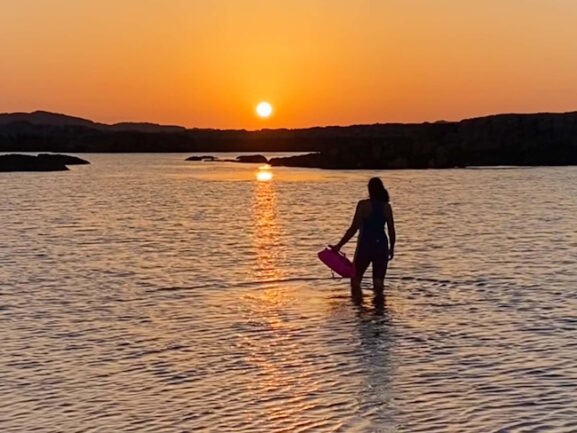
I started cold water swimming last April as part of NHS research, and I have found cold water swimming extremely beneficial for my widespread chronic pain. While I’m in the water it’s like a switch that gives me some much-needed respite from pain, although sadly my neck pain never seems to go. Having been wild swimming right through this past winter (down to water temps of 0.4° & smashing ice!), I was looking for another personal challenge and discovered the Great North Swim in Windermere, and the Epic Lakes Swim in Ullswater.
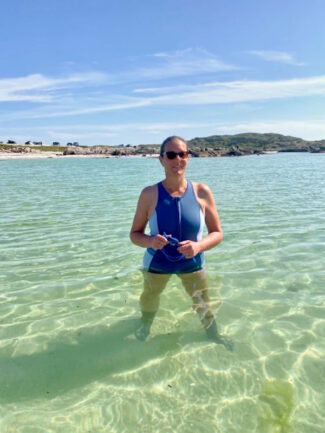
Myelopathy is limiting my ability to swim – I can no longer swim front crawl and am beginning to struggle with breaststroke due to the neck extension the stroke needs and the pain and the additional mobility difficulties this causes. This means that soon I will no longer be able to swim at all, so I wanted to ‘go out with a bang’, challenging myself physically and mentally, while also raising money for Myelopathy.org and awareness of the condition at the same time. Swimming two, one-mile lake swims may not sound like a lot, but for someone with Myelopathy every stroke is agony and takes a huge amount of effort that drains me for days afterwards, in addition to my usual fatigue. This means that one mile feels like a marathon. Because of my ‘wobbly’ walking and the effort of swimming, Simon is always there at the end of my swim to help me out, but I have also bought a large rubber duck tow float that is big enough to hold my walking sticks, and it looks pretty funny: me being chased through the water by an enormous yellow duck.
Why is raising awareness for Myelopathy so important to you personally and, what changes or improvements would you like to see for people living with Myelopathy?
Until my diagnosis I had never heard of Myelopathy, which seems to be a familiar story to many other people, despite experiencing symptoms for some time. Raising awareness about Myelopathy is important as the degenerative nature of the condition means that the sooner it is diagnosed, hopefully the sooner treatment can be provided in order to lessen lasting symptoms. I was really surprised to learn that Myelopathy is the most common spinal cord injury; however, it seems like no one knows about it, which is why awareness raising is so important. It also means that people will get a greater understanding of the experience of those with Myelopathy and hopefully promote empathy and patience when things take us a little longer to do or when we’re unable to do things like we used to.
What does Myelopathy.org mean to you and how has the charity supported you?
I have had chronic neck pain since an accident in my teens, so I really didn’t think much about the fact my neck pain had changed and increased in severity. I also accepted the loss of dexterity in my hands and strength in my wrists, my change of gait and difficulty walking, putting it down to the arthritis I have in a variety of joints. It wasn’t until I saw a spinal physiotherapist about lumbar spine pain that I was eventually referred for a spinal MRI and finally received a diagnosis of Degenerative Cervical Myeloradiculopathy. Receiving a diagnosis of Myelopathy, and trying to come to terms with the thought of having a ‘slow motion spinal cord injury’ needing spinal surgery is an enormous shock.
During my first appointment, my consultant directed me towards Myelopathy.org for information that explains Myelopathy in an understandable way. Like most health conditions, Myelopathy comes with its own set of acronyms and medical terms, and Myelopathy.org helps to decipher this. Not only was the information extremely helpful in the early stages of my journey, so too is the ongoing support provided through social media, including a Facebook group and Virtual Coffee mornings, allowing those with Myelopathy to share experiences, have questions answered or just to gain emotional support when times are more difficult; when the condition feels heavy, there are always others to help lighten the emotional load
What has been the biggest challenge of living with Myelopathy that people may not understand? How has Myelopathy affected your daily life, family life, or mental wellbeing?
Some of the biggest challenges of Myelopathy, for me, are not just living with the chronic pain, but learning to cope with the changes in life that the diagnosis, and symptoms brings. My life was already limited due to my other conditions, but it feels like Myelopathy made my world shrink even further. The guilt I feel when unable to do even basic things and having to rely on my husband, Simon, for help can be difficult to accept and live with, despite the fact he readily, willingly & lovingly gives support. Coming to terms with this has been a huge challenge and my mental health has most definitely been affected. As someone who is pretty much at the beginning of my Myelopathy journey, I’m not sure I’m the right person to give someone newly diagnosed advice. All I would be able to add is that it’s ok to admit that this can feel like a scary diagnosis and facing spinal surgery may be worrying, but accessing support from Myelopathy.org really does help; hearing real-life experiences of those who have gone though it is reassuring, as is all the information from Myelopathy.org
What message would you like to share with someone who has just been diagnosed with Myelopathy? What would you say to people who are considering donating or supporting Myelopathy Awareness Month?
For those considering donating to Myelopathy I would first of all say thank you. Despite being the most common spinal cord injury, Myelopathy is all but unheard of, until you or someone you love receives the diagnosis. The information and support provided by Myelopathy.org is essential and crucial to helping those facing spinal surgery and adverse experiences in their daily lives, including limited dexterity and mobility and increased pain. Without Myelopathy.org I would feel adrift, but because consultants are able to direct patients to Myelopathy.org for information and support, people just like me are able to face their future with Myelopathy with less uncertainty.