
Walking This Trail with Myelopathy
This is my first blog, and writing it feels like stepping slightly out of my comfort zone. I’ve never been particularly open about my health, even with those closest to me. But living with Myelopathy has reshaped not only my body, but also my understanding of myself. It feels important to begin by sharing what life looked like before the diagnosis.
My name is Lee Pollard. I’m 49 years old and a father to three adult children, aged 26, 28, and 30. My youngest has just qualified as a forensic scientist, my middle son is studying Health Sciences, and my eldest is a midwife, married with two children of her own. Yes, I’m a grandfather to a four- and six-year-old! I’m incredibly proud of what my children have achieved, and family has always been at the centre of my life.


Rewinding a little, for 28 years of my adult life I built a career in health and social care. That journey took me through children’s services, family support, fostering and adoption, mental health, and more recently into a role as a Registered Manager in domiciliary care for adults. It was a career that demanded focus, responsibility, and resilience. From the outside, everything appeared to function as it should. I was capable, productive, and dependable, and I assumed that the strain I felt was simply part of adult life and professional responsibility.
Before Myelopathy entered my life, my world was shaped by work, family, and hobbies I loved: scuba diving, kayaking, photography, and coastal walking. Like many people, I was balancing multiple roles, showing up for others while keeping life moving forward. Home was where I recharged, and family was the constant around which everything else revolved.
For years, life felt busy but manageable. I didn’t see myself as someone who was unwell. I was active, involved, and used to putting others first. Any aches, tiredness, or moments of struggle were easy to dismiss in the context of a full life. I assumed I was doing what everyone else was doing: just getting on with it.
When things began to change, they did so quietly. At first, it was clumsiness I laughed off, moments of unsteadiness I blamed on tiredness, or pain in my neck that I tried to ignore. Over time, those moments became harder to dismiss. Walking began to feel uncertain. My balance worsened, and weakness and stiffness crept into my arms and legs. Tasks that once felt automatic started to require concentration and planning.
Alongside this came numbness, tingling, and altered sensation — sometimes subtle, sometimes alarming. There were days when my body didn’t feel like my own, as though messages between my brain and limbs were delayed or lost. Fatigue became constant and overwhelming, and pain began to weave itself into daily life. I adjusted quietly, often without fully acknowledging how much effort everyday living was taking. There were days when simply moving my neck or trying to walk was extremely painful and debilitating.
Doubt was one of the hardest parts. I questioned myself constantly. Was this stress? Was I just exhausted? Was I failing to cope? I didn’t want to worry my family or admit that something might be seriously wrong, so I kept going, even as my independence slowly narrowed.
The journey to diagnosis took time. Myelopathy — a condition caused by damage or compression of the spinal cord — is often difficult to identify in its early stages. By the time it was diagnosed, the impact on my mobility, strength, and neurological function was undeniable.
Receiving the diagnosis brought both relief and grief. Relief at finally having an explanation for symptoms that had been quietly shaping my life for years. Grief for the version of myself who spent so long doubting and minimising what was happening. It became clear that this wasn’t something determination or resilience could fix — it was a medical condition that required understanding and adjustment.
Living with Myelopathy has changed my life in ways I am still coming to terms with. Reduced mobility, chronic pain, neurological symptoms, and profound fatigue are now part of my daily reality. Much of this is invisible, but its impact reaches into every part of my life, including my relationships and how I show up for my family. I can no longer do many of the activities I once loved.
What has changed most is my understanding of strength. Strength now looks like honesty, pacing myself, and accepting support — not just for my own sake, but for the people who care about me. It’s about learning to live differently, with greater awareness and self-compassion.
I’m sharing this because Myelopathy is often misunderstood and diagnosed late, and because I know how isolating it can feel to live with symptoms that don’t yet have a name. If any of this resonates, I hope it encourages understanding, earlier recognition, and a little more kindness toward yourself and others.
This is the beginning of my story, Walking This Trail with Myelopathy, and the start of what I hope will be an ongoing conversation.
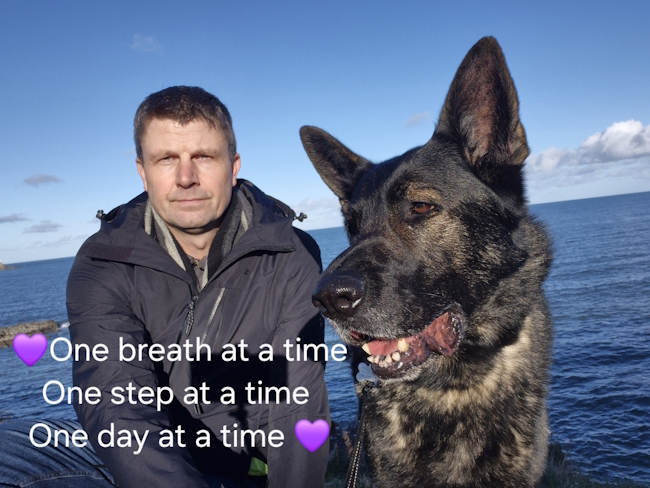
One step at a time. One breath at a time. One day at a time.
One comment
Comments are closed.
[…] my previous blog, I spoke about the life I once lived being active, outdoors,scuba diving, kayaking, and spending […]